



A fund can show a 12% annualized return while your SIP (Systematic Investment Plan) shows a different return. That does not mean the fund has delivered less than expected. The two figures can be based on different investment dates, cash flows, and measurement periods, so the fund’s reported performance may not match the return on your actual investment.
With a SIP, each instalment is invested at a different time and at the applicable Net Asset Value (NAV). Therefore, a fund’s reported 3-year return does not mean that every rupee in your 3-year SIP was invested for the full 3 years. Your personal XIRR (Extended Internal Rate of Return) accounts for the timing of your investments, which is why it can be higher or lower than the fund’s reported return.
What Is the Difference Between a Fund’s Return and Your SIP Return?
A mutual fund’s reported return shows how the scheme has performed over a specified period, based on changes in its NAV. Mutual fund schemes disclose their performance over various periods such as one, three, and five years, while the NAV reflects the value of the scheme’s investments.
However, your SIP return is linked to your actual cash flows. You invest a fixed amount at regular intervals, and each instalment buys units at the applicable NAV on a different date. As a result, the amount invested, investment date, and holding period can differ for each instalment.
| Factor | Fund’s Reported Return | Your SIP Return |
| Measures | Fund performance over a set period | Return on your SIPs |
| Investment pattern | Based on beginning and ending values | Based on multiple investments |
| Timing | Uses start and end dates | Each SIP has its own date |
| NAV impact | Tracks NAV change over the period | Units bought at each SIP’s NAV |
| Holding period | Same measurement period | Varies for each SIP |
| Return method | Based on the fund’s stated method | XIRR considers cash-flow dates and amounts |
| Tells you | How the fund performed | How your investment performed |
How SIP Timing Changes Your Investment Return
The timing of each SIP instalment affects the number of units you receive because the NAV can change between investment dates. When the NAV is lower, the same investment amount buys more units. When the NAV is higher, it buys fewer units.
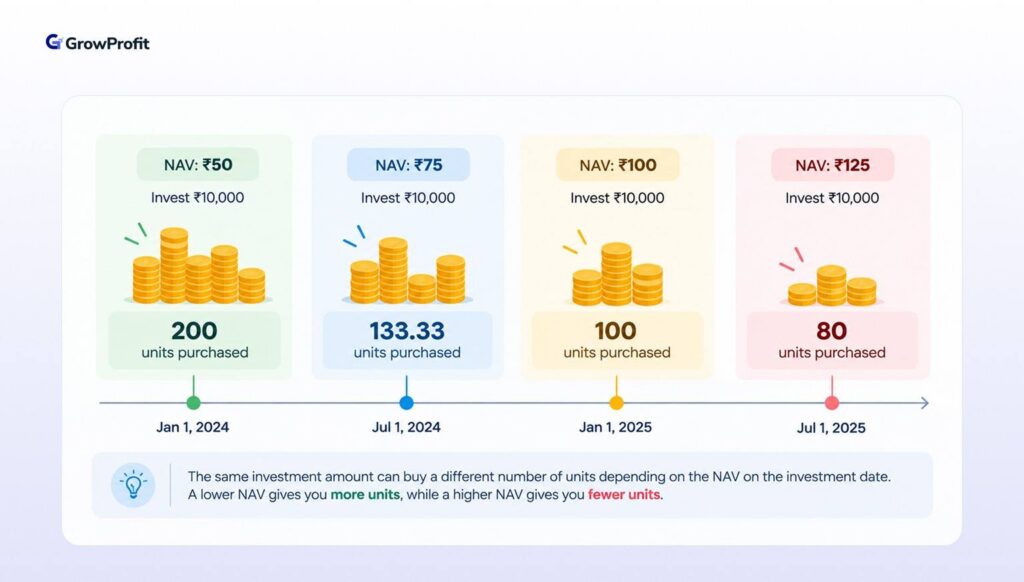
| NAV when ₹10,000 is invested | Units Purchased |
| ₹50 | 200 |
| ₹75 | 133.33 |
| ₹100 | 100 |
| ₹125 | 80 |
The difference becomes important over multiple SIP instalments. Each instalment may be made at a different NAV, so the number of units purchased and the gains or losses can vary from one instalment to another.
Why Two Investors in the Same Fund Can Earn Different SIP Returns
Two investors can invest in the same fund with the same ₹10,000 monthly SIP and still earn different returns if they start investing at different times. The difference comes from the NAVs at which their instalments are invested and how long each instalment remains invested.
Let’s understand with this simple example:
-
Investor A Starts Investing Earlier
Investor A starts in January, while Investor B starts in April. Both continue with a ₹10,000 monthly SIP.
| Month | NAV | Units Bought |
| January | ₹50 | 200 |
| February | ₹55 | 181.82 |
| March | ₹60 | 166.67 |
| April | ₹70 | 142.86 |
| May | ₹80 | 125 |
| June | ₹90 | 111.11 |
Investor A made a total investment of ₹60,000 from January to June, accumulating 927.46 units.
-
Investor B Starts Investing Later
Investor B’s SIP begins in April, so the same monthly investment buys units only at the later NAVs.
| Month | NAV | Units Bought |
| April | ₹70 | 142.86 |
| May | ₹80 | 125 |
| June | ₹90 | 111.11 |
Investor B made a total investment of ₹30,000 from April to June, accumulating 378.97 units.
How Different Investment Dates Affect XIRR
If the NAV later reaches ₹100, the value of both investors’ holdings would be:
| Investor | Total Units | NAV | Portfolio Value |
| Investor A | 927.46 | ₹100 | ₹92,746 |
| Investor B | 378.97 | ₹100 | ₹37,897 |
Investor A accumulated more units because some of the instalments were invested when the NAV was lower. However, this does not mean an earlier start will always produce a higher XIRR. If the NAV falls after Investor A starts, Investor B could benefit from buying more units at the lower NAV.
The example shows that investors in the same fund can earn different returns because their investment dates differ.
Other Reasons Your SIP Return May Differ From the Fund’s Return
-
Direct and Regular Plans
SEBI’s 2026 Mutual Funds Regulations provide for Direct and Regular Plans, which can have different expense ratios because their distribution structures differ. The two plans can therefore have different NAVs and returns even when they invest in the same underlying scheme.
-
Expense Ratio
The expense ratio represents the expenses charged to the scheme. These expenses are reflected in the NAV and can affect the return investors receive over time.
-
Exit Load
An exit load can reduce the amount an investor receives when redeeming units within the applicable period. SEBI’s scheme documentation gives the redemption price as the applicable NAV adjusted for any applicable exit load.
-
Taxes
Taxes can affect the amount you ultimately retain, so they should be distinguished from the fund’s reported pre-tax performance.
How to Compare Your SIP Return With Fund Performance
Before comparing your SIP return with a mutual fund’s reported return, make sure you are comparing the same scheme, plan, option, and period. The two returns may also use different calculation methods, so comparing the percentages directly can be misleading. When comparing, you should check these factors:
| Compare | Your SIP | Fund |
| Return metric | XIRR | CAGR |
| Cash flows | Your actual cash flows | Not based on your individual SIP instalments |
| Investment timing | Each investment date is considered | Measured over the fund’s specified period |
| Purpose | Measures your investment return | Measures the scheme’s performance |
For example, if a fund reports a 3-year CAGR of 12%, your SIP XIRR may be higher or lower than 12%. This is because your XIRR considers the dates and amounts of your actual SIP instalments, while the fund’s CAGR measures the scheme’s performance over the specified period.
Therefore, do not judge your SIP’s performance by simply comparing its XIRR with the fund’s reported CAGR. First check that the scheme, plan, option, period, and return methodology are comparable.
CAGR vs XIRR: Which Return Metric Should You Use?
CAGR and XIRR measure returns differently. CAGR is useful for understanding a fund’s annualized performance over a defined period, while XIRR accounts for the timing of multiple cash flows, making it useful for evaluating SIP returns.
| CAGR | XIRR |
| Measures annualized growth over a defined period | Measures annualized return considering the timing of cash flows |
| Best suited to a lump-sum investment or fund performance | Best suited to SIPs and investments with multiple cash flows |
| Assumes the investment grows from the starting value to the ending value over the period | Accounts for different investment and withdrawal dates |
| Useful for comparing a fund’s reported performance | Useful for evaluating your personal investment return |
Key Takeaway: Use CAGR to assess a fund’s reported performance and XIRR to assess the return on your own SIP.
How to Calculate Your SIP Return Using XIRR
XIRR calculates the annualized return when your investments are made on different dates. In a spreadsheet, XIRR uses the cash-flow amounts and their corresponding dates to calculate the annualized return.
Step 1: Enter Your SIP Dates
Enter the date of each SIP instalment in one column. In this example, six ₹10,000 instalments are made from January to June 2026.
Step 2: Enter the Cash Flows
Enter each SIP instalment as a negative value because it is money invested by you. Enter the investment’s value on the final date as a positive value.
| Date | Cash Flow |
| 6-Jan-2026 | -₹10,000 |
| 6-Feb-2026 | -₹10,000 |
| 6-Mar-2026 | -₹10,000 |
| 6-Apr-2026 | -₹10,000 |
| 6-May-2026 | -₹10,000 |
| 6-Jun-2026 | -₹10,000 |
| 6-Oct-2026 | +₹64,000 |
Total invested: ₹60,000 | Value on 6 October 2026: ₹64,000
Step 3: Enter the XIRR Formula
If the dates are in Column A and cash flows are in Column B, enter:
=XIRR(B2:B8,A2:A8)
The XIRR function requires at least one negative and one positive cash flow. The optional third argument, called guess, can be used as a starting estimate for the calculation, but it is not required in most cases.
In the screenshot, the formula is:
=XIRR(B2:B8,A2:A8,D4)
Here, D4 contains the optional starting estimate.
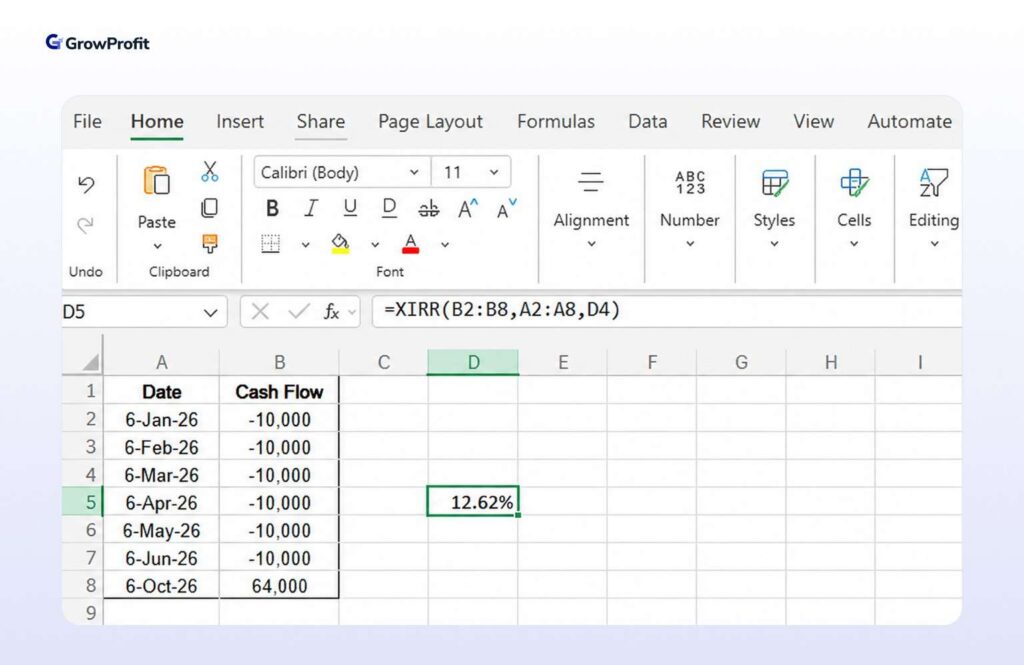
Step 4: Check the Result
The calculation gives an XIRR of 12.62%.
This means the annualized return based on these actual cash flows is 12.62%. XIRR considers both the amount and timing of each cash flow, so it reflects when your SIP instalments were invested.
What to Check After Calculating Your SIP Return
Once you have calculated your XIRR, compare it with the fund’s reported return for the same period. Also check that you are comparing the same scheme, plan, and option.
| Check | What to verify |
| Scheme | Same mutual fund scheme |
| Plan | Direct or Regular |
| Option | Same option |
| Period | The same start and end period |
| Return | XIRR vs. the fund’s reported return |
Compare like with like before deciding if your SIP has underperformed or outperformed the fund’s reported return.
FAQs
Why is my SIP return lower than the fund’s return?
Your SIP return can be lower because each instalment is invested at a different NAV and remains invested for a different period. The fund’s reported return measures scheme performance over a specified period, while your XIRR reflects the actual timing and amount of your SIP investments.
Can two investors in the same mutual fund have different returns?
Yes. Two investors in the same mutual fund can earn different returns if they invest at different times. Their instalments may be invested at different NAVs and remain invested for different periods.
Why does my SIP XIRR change every month?
Your SIP XIRR can change when you make new investments or when the current value of your mutual fund units changes. XIRR considers the timing and amount of your cash flows, so the calculated annualized return can change as your investment value and cash flows change.
Is XIRR or CAGR better for calculating SIP returns?
XIRR is suitable for calculating SIP returns because it considers the timing and amount of each investment. CAGR measures annualized growth over a defined period, such as a lump-sum investment or a fund’s reported performance.
Does the expense ratio affect my SIP return?
Yes. The expense ratio represents expenses charged to the mutual fund scheme and is reflected in its NAV. These expenses can affect the return you receive from your investment over time.
Do taxes and exit loads affect my actual mutual fund return?
Yes. An exit load can reduce the amount you receive when you redeem units during the applicable period. Taxes can also affect the amount you ultimately retain, so your actual post-tax return may differ from the fund’s reported return.
Why does my SIP return not match the return shown in the fund factsheet?
Your SIP return may not match the fund factsheet return because the two figures measure different things. The factsheet reports the fund’s performance over a specified period, while your XIRR is based on the dates and amounts of your actual SIP instalments.