


If your portfolio shows a TWRR of 14% and an XIRR of 9%, which one is your actual return? These two numbers can differ because they measure different aspects of your investment.
TWRR, or Time-Weighted Rate of Return, measures how the investment or strategy performed, regardless of when you added or withdrew money. XIRR, or Extended Internal Rate of Return, measures the annualized return on your actual investments, taking into account when you invested or withdrew money.
Put simply, TWRR tells you how the investment performed, while XIRR tells you how your money performed. The two numbers can be quite different when you make multiple investments, regular SIPs, withdrawals, or invest at different points in the market cycle.
TWRR vs XIRR: What’s the difference?
| TWRR | XIRR | |
| Full form | Time-Weighted Rate of Return | Extended Internal Rate of Return |
| Measures | Performance of the investment or strategy | Investor’s personal return |
| Effect of deposits and withdrawals | Neutralized | Included |
| Cash-flow timing | Does not affect the return measure | Can significantly affect the return |
| Useful for | Comparing investment strategies or portfolio managers | Measuring your own portfolio return |
| Common use in India | PMS Investment Approach performance | Investor-level PMS performance, SIPs and portfolios with irregular cash flows |
How does TWRR work?
TWRR measures the return earned by an investment between each cash flow.
When you add or withdraw money, TWRR treats that as the end of one period and the start of another. It calculates the return for each period and then combines them.
The basic TWRR formula is:
TWRR = [(1 + R₁) × (1 + R₂) × … × (1 + Rₙ)] − 1
Here, R₁, R₂, … Rₙ are the returns for each period between cash flows.
The formula becomes easier to understand with an example:
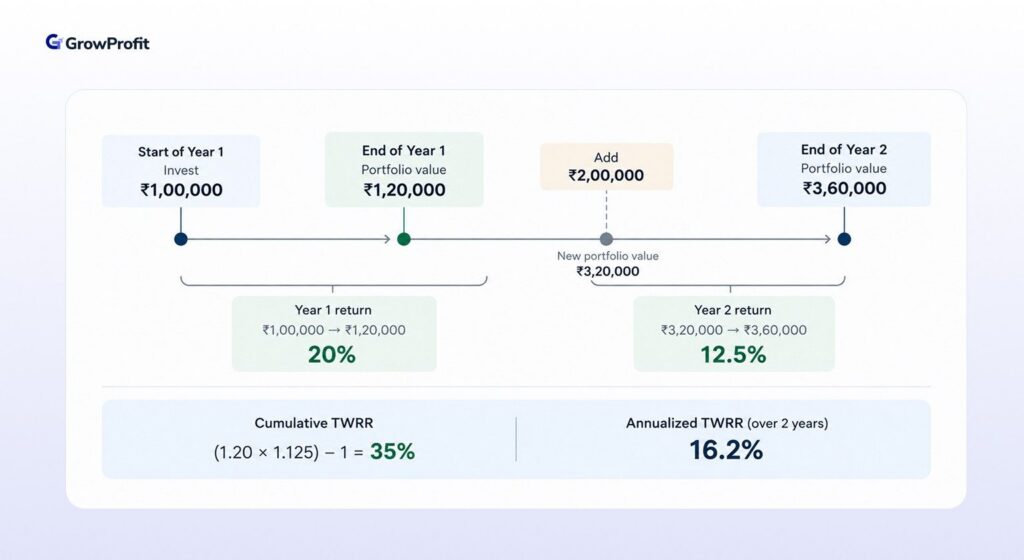
In this example:
TWRR = (1.20 × 1.125) − 1 = 35%
The annualized TWRR over two years is approximately 16.2%.
The ₹2 lakh added between the two periods is treated as a cash flow, not investment performance. TWRR measures how the investment performed during each period, regardless of when money was added or withdrawn.
How does XIRR work?
XIRR looks at your actual cash flows and the dates on which they happened.
Money you invest is treated as a cash outflow. Money you receive or the current value of your investment is treated as a cash inflow. XIRR then calculates the annualized return that connects those cash flows.
For example, imagine you make these investments:
| Date | Cash flow | Transaction |
| January 1, 2025 | -₹1,00,000 | Initial investment |
| January 1, 2026 | -₹2,00,000 | Additional investment |
| January 1, 2027 | +₹3,60,000 | Current portfolio value |
XIRR considers both the amount invested and how long each amount was invested. For these cash flows, the XIRR is about 14.5%.
When TWRR is the better measure
If you’re comparing investment strategies, TWRR helps you focus on how the strategy performed rather than when money was added or withdrawn.
For example, if you’re comparing two portfolio managers, the investors in their portfolios may add or withdraw money at different times. TWRR separates the periods around these cash flows, so you can assess how the portfolio performed rather than letting the timing of those cash flows change the result.
When XIRR is the better measure
If you want to know how your own money performed, XIRR gives you a return that reflects when you invested and withdrew money.
Your investments rarely happen at exactly the same time. You may make monthly SIPs, add a lump sum when the market falls, withdraw part of your portfolio, or make an occasional top-up. XIRR takes the date of each cash flow into account.
For example, if you invested ₹50,000 six months ago and another ₹50,000 last month, both amounts are part of your portfolio today, but they have been invested for different lengths of time. XIRR accounts for that difference when calculating your annualized return.
Excel’s XIRR function is designed for cash flows that occur at irregular intervals and uses the date of each cash flow in the calculation.
TWRR and XIRR in PMS
Portfolio Management Services (PMS) is a good example of why TWRR and XIRR can give you different numbers.
SEBI’s PMS reporting framework uses TWRR to report the performance of an Investment Approach. Investors can also see XIRR, which reflects the return on their own investment based on their cash flows.
The two numbers can differ because investors may enter or exit the PMS at different times. The amount they invest can also vary, and their portfolios may differ because of individual circumstances or restrictions.
So, if a PMS factsheet shows a 15% TWRR while your statement shows a 10% XIRR, the numbers are not necessarily contradictory. The 15% reflects the performance of the Investment Approach, while the 10% reflects the return on your own money.
SEBI also requires PMS disclosures to state that an investor’s performance may differ from the Investment Approach’s performance because of factors such as the timing of investments and withdrawals.
What about SIPs?
For Systematic Investment Plans (SIPs), XIRR is generally the more useful number for gauging your personal return. Each SIP installment has a different investment date. Your January installment may have been invested for several years, while your latest installment may have been invested for only a few weeks.
XIRR considers all those cash flows and their dates when calculating the annualized return. That makes it more meaningful than a simple return calculation when you want to know what you actually earned on your SIP investment.
TWRR vs XIRR vs CAGR
CAGR is useful when you make a single investment and leave it invested without adding or withdrawing money.
For example, if you invest ₹1 lakh and it grows to ₹1.5 lakh over three years, CAGR can tell you the annualized growth rate over that period.
Once you start adding or withdrawing money at different times, CAGR no longer gives you the right way to measure your personal annualized return. XIRR is better suited to those cash flows.
TWRR has a different purpose altogether. It measures investment performance without the effect of external cash flows.
| Return measure | What it tells you | Best suited for |
| CAGR | Annualized growth between two values | A single investment with no intervening cash flows |
| TWRR | Performance of an investment or strategy | Comparing strategies, managers or benchmarks |
| XIRR | Annualized return based on your actual cash flows | SIPs, withdrawals and irregular investments |
Before you compare the two returns
Before comparing a TWRR with an XIRR, make sure you’re looking at the same period and the same portfolio or Investment Approach. Otherwise, the comparison can be misleading.
A few things are worth checking:
- Are both returns annualized? XIRR is an annualized return. Don’t compare it directly with a simple percentage gain over the investment period.
- What cash flows did you make? Large deposits or withdrawals can have a big effect on your XIRR.
- Are fees and expenses included? Check whether the returns are shown before or after applicable fees and expenses.
- Are you comparing against the right benchmark? If you’re evaluating an investment strategy, use the relevant benchmark for the same period.
- Are the periods the same? A one-year return and a five-year annualized return don’t tell you the same thing, so they shouldn’t be compared directly.
Which return number should you trust?
There isn’t one return number that’s always better. It depends on what you want to find out. If you’re trying to judge how an investment strategy or portfolio manager performed, TWRR is generally the better number to look at because it isn’t affected by the timing of investor cash flows.
If you’re trying to find out how your own money performed, XIRR is usually the better fit. It takes the dates and amounts of your investments and withdrawals into account.
If you made one lump-sum investment and didn’t add or withdraw any money, CAGR may be enough to describe your return. So, if you see a TWRR of 14% and an XIRR of 9%, don’t assume the 14% is automatically the better return.
TWRR tells you how the investment performed. XIRR tells you how your money performed.
FAQs
Can TWRR and XIRR be the same?
Yes, they can be the same when there are no external cash flows affecting the calculation, such as when you make a single investment and leave it untouched for the entire period. In that situation, there is no difference between the investment’s time-weighted performance and the return on your own money.
Can XIRR be higher than TWRR?
Yes, XIRR can be higher or lower than TWRR depending on when you invested or withdrew money. For example, if you invest a large amount just before the portfolio rises, your personal return can be higher than the portfolio’s time-weighted return. If you invest heavily just before a fall, your XIRR can be lower.
Can XIRR be negative?
Yes, XIRR can be negative if the value you receive from the investment is less than the value of your cash flows, taking their timing into account.
A negative XIRR means your investment did not generate a positive annualized return over the period being measured.
Does XIRR include the current value of my investment?
Yes. When calculating XIRR for an investment that you still hold, the current value of the investment is treated as a cash inflow on the date of the calculation.
For example, if you have made several SIP investments and still hold the units, the calculation uses your SIP payments as outflows and the current portfolio value as the final inflow.
Why does my SIP XIRR change even when I haven’t invested any more money?
Your XIRR can change as the value of your investment changes. The calculation uses your existing cash flows and the current value of your portfolio, so a change in the portfolio value can change the resulting XIRR even if you have not made a new investment.
Should I compare my XIRR with a mutual fund’s CAGR?
Not directly. Your XIRR reflects the timing of your own investments and withdrawals, while a fund’s published CAGR generally describes the growth of the investment over a specified period.
If you want to compare your personal return with a benchmark or fund performance, make sure the periods, return measures, and cash-flow assumptions are comparable. Comparing a personal XIRR with a fund’s point-to-point CAGR can give you a misleading picture.
What happens to XIRR if I partially withdraw my investment?
The withdrawal becomes part of your cash-flow history. The amount and date of the withdrawal are included in the XIRR calculation along with your earlier investments and the remaining value of the portfolio. This is one reason XIRR is suited to investments where money moves in and out at different times.